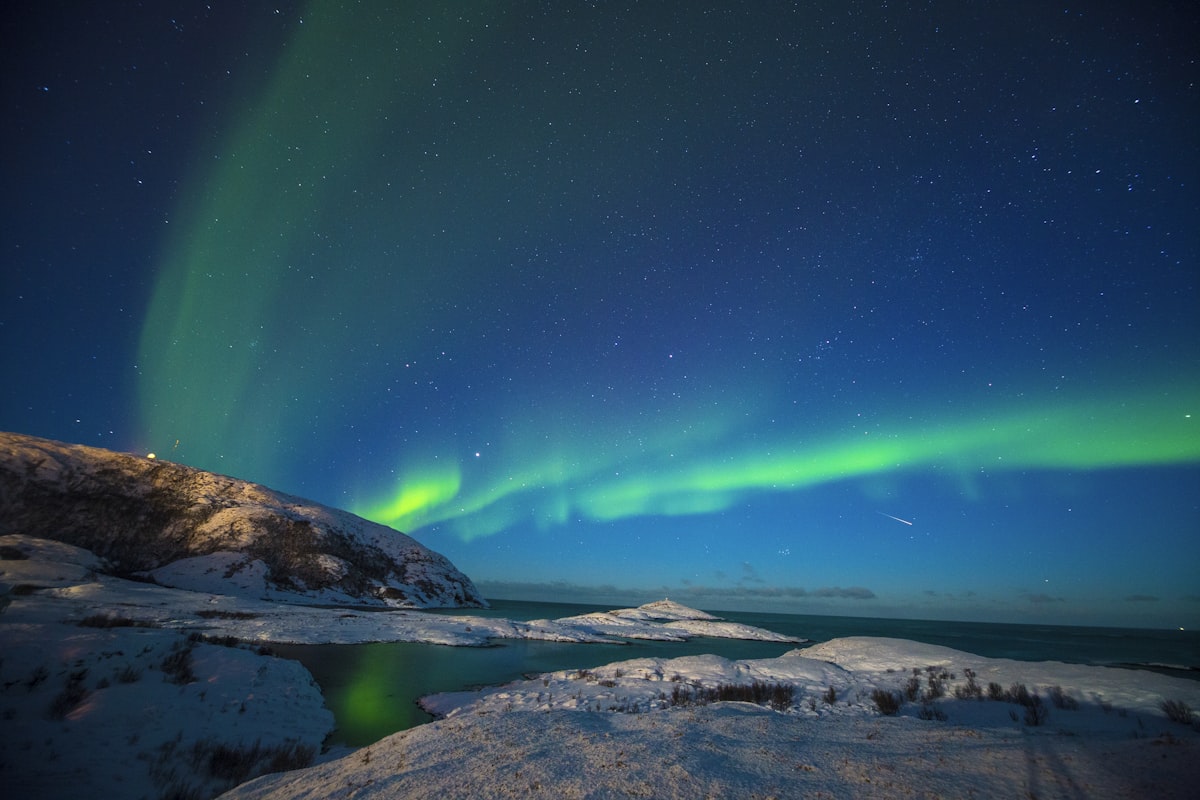
Tromsø vs. Abisko: The Definitive 2026 Aurora Destination Guide
Two destinations. One solar cycle. The choice between Norway’s vibrant aurora-chasing metropolis and Sweden’s legendary “Blue Hole” will define your entire Arctic expedition. This is the definitive 2026 comparison.
The Apex of Arctic Aurora Destinations
The pursuit of the aurora borealis has catalyzed an unprecedented surge in high-latitude winter tourism, and at the epicenter of this pursuit lie two undisputed titans: Tromsø, Norway, and Abisko, Sweden.
These destinations sit a mere few hundred kilometers apart across the Scandinavian Mountains, yet they represent radically divergent aurora philosophies. Tromsø is a sophisticated urban center that attacks the unpredictability of Arctic weather with motorized mobility, chasing clear skies across hundreds of kilometers. Abisko is a remote wilderness outpost that has ascended to global fame through a highly specific meteorological anomaly — the “Blue Hole” — where the aurora hunt transforms from frantic pursuit into serene, stationary vigil.
Selecting between them for 2026 requires understanding solar physics, meteorology, logistics, and your personal travel philosophy.
Astrophysical Context: Solar Cycle 25 in 2026
Before diving into destination specifics, understanding the 2026 solar environment is critical.
The Declining Phase Advantage
The year 2026 sits squarely in the early declining phase of Solar Cycle 25, which peaked between late 2024 and late 2025. A pervasive misconception suggests aurora viewing drops off precipitously after solar maximum. In reality, the months following peak are historically renowned for producing some of the most dramatic, widespread auroral displays of the entire cycle.
During this declining phase, the sun’s magnetic fields undergo complex reorganization. While daily sunspot counts may begin to wane, the severity of individual geomagnetic storms often remains elevated. The sun continues to unleash powerful coronal mass ejections (CMEs) and fast solar wind streams from persistent coronal holes.
For travelers to extreme high latitudes like Tromsø and Abisko, this is ideal. By positioning beneath the auroral oval, even baseline ambient solar wind produces spectacular nightly displays — no massive solar storms required.
The Russell-McPherron Effect
Traveling in March or October 2026 capitalizes on the Russell-McPherron effect. During these equinox periods, Earth’s magnetic dipole is optimally tilted to connect with the interplanetary magnetic field, significantly increasing aurora likelihood. December through January provides the longest darkness (12–15 hours of viewing time) but carries the highest risk of vision-obscuring winter storms.
The Meteorological Showdown: Cloud Cover and Microclimate
If geomagnetic positioning of Tromsø and Abisko is functionally equal, the true battleground is meteorology. The single greatest enemy of the aurora chaser is cloud cover.
Tromsø: The Gulf Stream Paradox
Tromsø sits deeply influenced by its coastal geography and proximity to the North Atlantic Current, an extension of the Gulf Stream. Winter temperatures hover around a manageable −4°C (25°F) — dramatically more comfortable than the −30°C deep freezes of inland Scandinavia.
However, this thermal moderation comes at a steep meteorological cost: intense precipitation, high humidity, and persistent thick cloud cover. As warm, moist air from the Norwegian Sea meets freezing Arctic air masses, it condenses into heavy snow squalls and dense coastal clouds.

Meteorological data reveals that in December, Tromsø’s sky is historically overcast or mostly cloudy roughly 79% of the time. Stationary aurora viewing from a hotel balcony is statistically unreliable.
To achieve Tromsø’s advertised 85% aurora success probability, visitors must actively circumvent the weather. Specialized “Aurora Chasing” tours analyze localized weather models minute-by-minute and drive 100–200 kilometers inland — into Finland or Sweden — to find clear skies. This transforms the aurora experience into a 6–8 hour motorized pursuit rather than a tranquil vigil.
Abisko: The Blue Hole Phenomenon
Abisko possesses what meteorologists consider the most favorable microclimate for aurora viewing anywhere within the global auroral oval. This phenomenon is the “Blue Hole of Abisko” — a localized weather pattern consistently providing more clear nights than any surrounding region.
The science: prevailing westerly weather systems carry immense moisture from the Atlantic. As these air masses are forced upward by the Scandinavian mountain range, they cool, condense, and dump moisture as heavy precipitation on the Norwegian side. By the time these battered systems crest the 1,191-meter Mount Nuolja and descend into Abisko valley over frozen Lake Torneträsk, they have been stripped of moisture. The dry air dissipates any remaining clouds, creating a persistent tear in the cloud cover hovering directly above Abisko National Park.
Statistical weather modeling confirms Abisko’s efficacy. Visitors staying 3–4 nights have an estimated 80%–90% probability of witnessing the northern lights. Most crucially, there is no need for exhausting 200-kilometer bus chases — visitors can observe world-class displays by simply stepping outside their lodge.

Light Pollution: The Bortle Scale Reality
Tromsø: Urban Glow
As a modern municipality of 40,000 with major port facilities, an international airport, and illuminated infrastructure, Tromsø generates significant light pollution. The city center registers Bortle 7–8, washing out weaker aurora displays (Kp 1–2). Capturing professional-grade photography requires driving 30–45 minutes into surrounding dark fjords like Ersfjordbotn or Kattfjord.
Abisko: True Dark Sky
With a permanent population hovering around 100, Abisko produces negligible artificial light. The skies above Abisko National Park represent true Bortle 1–2 dark sky territory. The complete absence of urban glow means even the faintest auroral activity is visible from village streets. For astrophotographers, this allows exceptionally clean, low-noise long-exposure images without extensive post-processing to remove urban light pollution.
Beyond Aurora: Daytime Activities
An absolute rule of Arctic travel: never build an itinerary entirely around the aurora. A successful expedition requires engaging daytime activities regardless of solar output.
Tromsø: Cultural and Marine Metropolis
Tromsø’s urban infrastructure offers diverse daytime activities:
Whale Watching: The herring run (October–January) makes deep Norwegian Sea waters a globally renowned feeding ground for orcas and humpback whales. The 2025/2026 season features sustainable hybrid-electric catamarans. Full-day fjord cruises range from 1,995–2,255 NOK (~$190–215 USD), while high-speed RIB safaris command $340+ USD.

Sámi Cultural Experiences: Operators like Tromsø Arctic Reindeer offer reindeer sledding (10–30 minute experiences), herd feeding, traditional Sámi meals in fire-lit lavvu tents, and joik (traditional folk singing). Tours priced 1,690–2,090 NOK per person.
Urban Events (Q1 2026):
- Tromsø International Film Festival: January 19–25
- Polar Night Marathon: January 3
- Sámi Week: January 31 – February 7 (featuring high-speed reindeer racing through city streets)
Abisko: Wilderness and Astrophotography
Abisko’s activities lean toward outdoor endurance and photography:
Aurora Sky Station: The crown jewel — a facility 900 meters above sea level on Mount Nuolja, accessible via silent 2-kilometer chairlift. Offers sweeping 360° panoramic views, guided evening tours, and an expansive outdoor viewing terrace. Base chairlift tickets begin at 220 SEK for STF members; comprehensive evening packages require booking weeks in advance.
Kungsleden Dog Sledding: The northern terminus of Sweden’s famous King’s Trail. Standard 2-hour husky rides begin around $215 USD; self-drive mushing experiences cost roughly $224 USD.
Professional Astrophotography Workshops: Göran Strand’s February 11–15, 2026 workshop offers intensive personal coaching and deep-dive image editing — catering specifically to the hardcore photography demographic.
Logistical Realities: Transportation
Tromsø: Accessible Hub
Tromsø Airport (TOS) operates as a major regional aviation hub with dozens of daily direct flights from Oslo (1hr 50min). International carriers offer direct winter-season flights from London, Copenhagen, Stockholm, and Helsinki. Tromsø is also a major Hurtigruten coastal ferry port.
Abisko: The Slow Travel Romance
Abisko’s remoteness requires more effort. Primary gateway is Kiruna Airport (KRN), followed by 1.5-hour train/bus transfer.
The most iconic approach: the SJ Arctic Sleeper Train from Stockholm Central Station — a 16.5–17 hour journey covering 1,300+ kilometers through frozen boreal forest. One-way tickets average 1,900–3,300 SEK depending on cabin class. This overnight journey is favored by slow-travel enthusiasts transitioning from urban sophistication straight into Arctic wilderness silence.
The Narvik Connection: Combining Both
For travelers with 7–10 days, combining both destinations is highly recommended. The “Arctic Route” bus (Best Arctic) runs daily from Narvik to Tromsø, departing 2:00 PM, arriving 6:25 PM — a spectacular 4-hour journey crossing the Hålogalandsbrua suspension bridge. Tickets: 790–950 NOK.
Financial Architecture: Budget Comparison
Tromsø: High-End Comfort
Norway’s pricing reflects its high standard of living. A realistic daily budget for comfortable mid-range stays (3-star hotel, mix of dining, organized tours) ranges $150–250+ USD per person per day, excluding international flights.
Additional mandatory costs: Aurora Chasing tours at $150–200 USD per night to escape coastal clouds.
Abisko: Utilitarian Value
Abisko offers slightly more palatable economics: $120–200 USD daily. The defining characteristic is extreme infrastructure scarcity — no large resorts or luxury retreats.
Accommodation ecosystem:
- STF Abisko Turiststation: Primary hub offering dorm beds to private rooms. Basic hostel beds ~€45; private rooms significantly higher. Features communal guest kitchens and the Kungsleden restaurant (KRAV-certified organic local produce).
- Abisko Mountain Lodge: “Nicest” option in the village — traditional Swedish cuisine, cozy wilderness rooms.
- Abisko Guesthouse & Activities: Budget-focused with shared facilities.
Because capacity is strictly capped, Abisko routinely sells out 12+ months in advance. Last-minute travelers will be forced to stay in Kiruna (100km away).
The cost-saving advantage: the Blue Hole’s clear skies mean aurora viewing requires no expensive tours. Independent viewing within the national park is free, saving hundreds over multi-night stays.
Side-by-Side Comparison
| Factor | Tromsø, Norway | Abisko, Sweden |
|---|---|---|
| Geomagnetic Latitude | ~67° N (Kp 1-2 for overhead) | ~65-66° N (Kp 1-2 for overhead) |
| December Cloud Cover | 79% overcast | Lowest clear-sky % in Europe |
| Light Pollution | Bortle 7-8 (city center) | Bortle 1-2 (National Park) |
| Viewing Strategy | Motorized chasing (100-200 km) | Stationary viewing (free, on foot) |
| Daily Budget | $150–250+ USD | $120–200 USD |
| Accommodation | Luxury hotels, glass igloos | Utilitarian STF hostels/lodges |
| Aurora Tour Cost | $150–200 USD/night (mandatory) | Free to $100/night (rarely needed) |
| Daytime Activities | Whale watching, Sámi culture, urban events | Dog sledding, Aurora Sky Station, photography workshops |
| Accessibility | Direct international flights | Sleeper train or Kiruna connection |
| Trip Duration | 3-5 nights typical | 3-4 nights sufficient |
Strategic Recommendations: Which Destination for Who?
Choose Tromsø If You Are:
- First-time Arctic travelers seeking accessible infrastructure
- Luxury seekers wanting high-end accommodations and fine dining
- Families with children who need diverse activities
- Marine wildlife enthusiasts (orcas, humpback whales)
- Cultural immersion seekers (Sámi heritage, Arctic museums)
- Prepared to spend late nights on buses chasing clear weather
Choose Abisko If You Are:
- Hardcore astrophotographers prioritizing dark skies and pristine foreground compositions
- Nature purists who prefer wilderness isolation
- Budget-conscious wilderness backpackers willing to plan 12+ months ahead
- Travelers whose singular priority is maximizing clear-sky aurora probability
- Slow travel enthusiasts who romanticize overnight train journeys
- Comfortable with limited dining options and utilitarian lodging
Consider Both If You Have:
- 7–10 days available
- Desire to experience both Norwegian coastal culture and Swedish wilderness silence
- Willingness to navigate cross-border logistics between Norway and Sweden
2026 Timing Recommendations
| Month | Pros | Cons | Best For |
|---|---|---|---|
| September–October | Shoulder season pricing, autumn colors | Milder temps, shorter nights | Budget travelers |
| November–December | Peak Christmas season, maximum darkness | Premium pricing, storm risks | Luxury seekers, event travelers |
| January–February | Ultimate darkness, intense aurora displays | Extreme cold (-20°C to -35°C), 4-5 hrs daylight | Serious aurora photographers |
| March | Aurora still active, warming temps, equinox effect boost | Variable weather, mud season | Photographers, value seekers |
Ready to choose your 2026 aurora adventure? Check our real-time aurora forecast for optimal viewing conditions, and browse our aurora photography gear guides before you go.